Why Kids Need the Chance to Practice Agency, Failure, and Problem-Solving
This talk was delivered to “Our Community Chamber” in August 2026. This transcript has been lightly edited for clarity and readability while preserving the content and language of the original talk.
When I first moved to Goddard, I don’t know if anybody remembers the very first Main Street Market I went to, two and a half, maybe, three years ago. My booth was Ellis in Wanderland. I’m also very punny, so yes, Ellis in Wanderland for Leah Ellis. It was tons of fun, and I loved it.
I also had Endeavor Financial Coaching. I taught financial literacy to grownups, and I heard the same thing from adults over and over again:
“Why didn’t anybody teach me this when I was a kid?”
So I wrote a curriculum and started teaching it to kids.
It’s been so much fun. I love it.
I also recently launched Fireflies and Flowers Press. It is a publishing company that publishes books written by child authors. We sent our first book to print last night, so we officially published the first book from our publishing company. It’s very exciting.
But today, I want to talk to you about entrepreneurship as a life skill.
Entrepreneurship Is a Way of Thinking
At the Society of Child Entrepreneurs, we teach financial literacy, leadership, and entrepreneurship by letting kids start and manage their own businesses.
If you don’t want your kid, grandkid, niece, nephew, cousin, or whatever to be a business owner, you might not immediately see the benefit in sending them to the Society of Child Entrepreneurs.
But think about it.
Have you ever gone into business and only felt like you were running a business?
How many million other skills do you learn when you do entrepreneurship?
Think about what we picture when we hear the word entrepreneur.
Business owner.
It could be a mom with an Etsy shop. It could be a lawn-mowing company. A startup. An invention.
It’s really easy to get these ideas of what we think an entrepreneur is, and they’re very black and white.
But your therapist in private practice is an entrepreneur. A nurse practitioner with her own clinic is an entrepreneur.
Entrepreneurship isn’t just selling a product. It is producing a service and helping your community.
What if entrepreneurship really is this broad?
It’s not just that guy who started a business on the corner. It’s every person in a community trying to solve a problem and make it better.
What happens if we start thinking about entrepreneurship not as a career or a vocation, but as a mindset? A behavior? Something that we want to build in the people around us because we want to see our entire community doing better?
Entrepreneurship is a way of thinking.
When I teach my students, I tell them one of the keys to being an entrepreneur is problem-spotting.
Spend a day writing down all the things that annoy you.
I lost my earring back.
My shoe isn’t fitting the way it should.
The traffic light is too slow.
Write it all down. Every little problem. Spend the day noticing them. Practice problem-spotting.
Then take initiative.
What can you do to solve that problem?
Your kid is upset because their shoes are never where they’re supposed to be. What system can they put into place to make sure the shoes actually get into the shoe box?
Because I know you already have a shoe box.
Your kid’s just not using it.
Then you take that initiative, that problem you’ve solved, and you tell people about it and the value it can provide to their lives.
That’s the key to entrepreneurship:
Find a problem. Create a solution. Take it to market.
You can do that whether you’re six, sixteen, seventy-six, eighty-six, or anywhere in between.
Those skills go across all generations.
Kids Are Already Problem-Solvers
Our kids are especially good at it.
How many crazy ideas have your kids come up with?
“Mom, I want to sleep on Mars tonight.”
“You can sleep in your bed.”
“No. I want to sleep on Mars.”
Okay. What if we make the kitchen look like Mars?
Kids want to solve problems. They want to do things by themselves. They want to be creative. They have ideas and perspectives that we don’t have.
And they are so good at problem-solving.
My ten-year-old got mad about something in our community, went to city council, and got a process started.
All these grown-ups knew something needed to happen.
The kid said, essentially, “Why don’t we actually talk about the problem?”
We’re not giving them the opportunity.
We Teach Kids to Wait
We teach them to wait.
“Wait until the grown-up is finished talking.”
“Now isn’t a good time for your ideas.”
“We already have a system in place.”
“Wait until you’re older.”
“Your opinion doesn’t matter because you’re not old enough to vote.”
Wait.
Who in this room, by the time they were ten, was already really tired of grown-ups telling them to wait or go away? That children should be seen and not heard?
So why are we still doing it?
We hated it.
And then we kept doing it.
Then kids turn eighteen, and suddenly their vote does matter. They do have a say. They can participate in their community.
And pardon my French, but they just don’t give a damn.
We already bred apathy into them.
We told them for almost two decades:
“None of your great ideas matter because you’re just a kid.”
Then they’re adults, and suddenly their ideas matter?
How does that build them up?
They’ve spent their childhood being told their ideas don’t matter. Now they’re adults, and suddenly we want them to fix the problems around them.
How?
You told them they don’t matter.
We have to stop telling our kids to wait.
Because if we’re constantly telling them to wait, what they’re hearing is:
“We don’t care what you have to say.”
Then they build a future where they believe nobody cares what they have to say.
What if we started younger?
That’s what we do at the Society of Child Entrepreneurs.
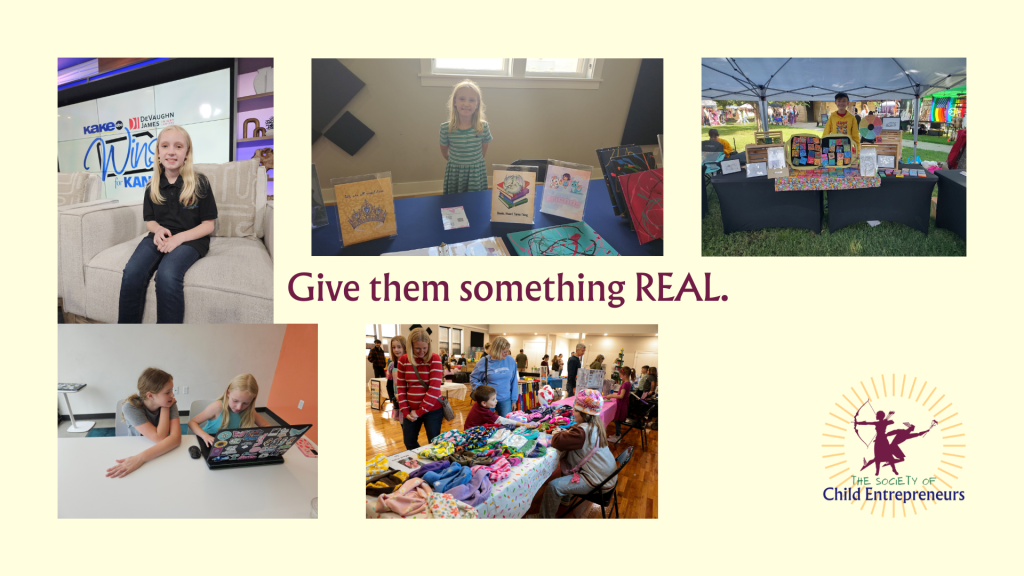
Give Them Something Real
I don’t teach kids to model businesses.
I don’t teach kids business in theory.
On September 13, I will have fifteen kids at the final Goddard Main Street Market of the year.
They will set up their businesses.
They will manage their own payment processes.
They will manage their own customer interactions, merchandising, inventory, and retail space.
Because you know what they get at the end of the day?
Cash.
Want to know a really good way to get a kid to listen to you?
Offer them cash.
But these kids aren’t just learning how to make bracelets and sell them on a street corner.
They’re learning how to talk to strangers.
They’re learning how to give an elevator pitch.
They’re learning how to communicate not just the benefit of their product, but why they love doing it and what their goals and dreams are.
They’re learning that even if a judge walks up with a clipboard and starts asking questions, they can answer those questions confidently.
How many of you could do that right now?
If I said we were going to start judging your businesses right now?
My ten-year-olds do it every three months with a smile on their faces.
Because they’re invested.
They care.
They’re learning.
And they think they’re making money and having fun.
I know they’re learning so much more.
They’re learning to calculate how much money they’re making compared with the cost of materials and credit card processing fees.
They’re learning to double-check their math because they don’t want to be short money at the end of the day.
They’re learning how much product to put on a table. They don’t want so much that it looks like nobody is buying, but they don’t want so little that people are afraid to come over.
They’re learning merchandising and what makes people want to come in.
Maybe they’re going to grow up and be an interior decorator because they learned how to merchandise a table.
Who knows what they might learn someday?
They’re practicing these things now, in an environment where they’re having fun and they’re part of the community.
Failure Is Data
And failure isn’t bad.
Not one of my kids has ever come to me and said:
“I didn’t make enough money at the Children’s Business Fair, so I’m shutting down my business. I’m done. I quit.”
Failure isn’t bad.
It’s a way for them to fail forward.
Fabulous. What went wrong?
Why didn’t you sell what you wanted to sell?
Was it a reasonable goal, or was it just a bad sales day?
Was your merchandising wrong?
Were your prices wrong?
Did you have enough inventory to reach the goal you wanted to reach?
Every failure becomes data.
And that data becomes behavior they already have ingrained in them when they become adults.
How many of you feel like work would be a little less stressful if your coworkers saw failure as data and not the end of the world?
We all know grown-ups who see failure as personal.
But I get to teach these kids:
Failure is just data.
Fail forward and keep going.
Do it again.
Fail in a different way next time so we can test what does and doesn’t actually work.
Agency Is Learned Through Action
Agency is learned through action.
We can’t tell a child:
“You are in control of your body. You’re in control of your future. You get to decide what kind of life you’re going to live.”
Not if we never let them practice it.
And what’s the best time to practice agency?
Childhood, when the risk is low.
If my ten-year-old starts a business, puts $100 into it, it flops, she loses all her money, never makes a penny, and people make fun of her for it, what has she lost?
A hundred dollars.
What has she gained?
Insight into what the market does and doesn’t want.
Insight into the people she does and doesn’t want as friends.
The ability to communicate with people.
Resources and knowledge for whatever business might come next.
The ability to fail and move forward.
Emotional regulation.
That’s worth $100 fifty times over, at least for what my kids will invest in it.
My ten-year-old has stood at a podium in the Kansas House of Representatives and testified about changing legislation.
Several of you have seen her speak at city council.
She comes to networking events with me.
Someone once stopped her and asked, “Do you have a business?”
She said, “Well, two, actually, but we’re here to talk about my mom.”
Come on.
That’s agency.
Agency is learning what you’re going to do and doing it.
We can’t lecture our kids into these beliefs.
They have to be able to practice them.
Our Goal Isn’t More CEOs
Our goal isn’t just to build more CEOs.
Do I think entrepreneurship is the backbone of community?
Yes.
Do I think entrepreneurship is a necessity of every economy everywhere?
Absolutely.
Do I think we need 57,000 new CEOs to run 57,000 new companies?
No.
We need teachers.
We need nurses.
We need bus drivers and mechanics and farmers.
Do you know what all of those careers still need?
The ability to think through a problem.
The ability to communicate.
Emotional regulation.
And the financial literacy to not go bankrupt trying to live their life on whatever they’re earning.
Our goal isn’t just more CEOs.
Our goal is an entire culture where the entrepreneurial mindset is celebrated.
How do we build a culture where problem-solving, creativity, and failing forward are normal?
We give kids something real.
We let them do it.
I’ve watched my daughter accept a $500 grant on KAKE and sell her own graphic designs at a business fair.
I’ve watched one of my students make $300 selling five-by-five paintings at ICT Big Gay Market in one day.
Last December, I had fifteen kids inside the Goddard Community Center selling their products and showing the community what kids can do.
But one of my favorite examples is Food for Friends.
What Child Leadership Actually Looks Like
We say we teach financial literacy, leadership, and entrepreneurship.
Entrepreneurship and financial literacy go together pretty easily. People can see that connection.
But they ask me:
“How do you teach leadership? What does that look like?”
Food for Friends is what that looks like.
Melody and Kaylee spent their summer vacation meeting every Friday, interviewing community and religious leaders, learning everything they could about hunger in Wichita, and building a program that will feed 250 residents of Wichita on September 7 at Central Riverside Park.
They’re giving away 125 copies of a book they wrote with the purpose of reducing the stigma around accessing food resources.
And to top it all off, they’re doing their own fundraising and community outreach.
You know what I do?
I give them a checklist of goals every week.
If they get off track, I say:
“Hey, girls. Which goal are we working on?”
I’m their mentor.
I’m not running this project.
I would have never said, “You know what? We only have three months to do this project. Let’s write a book.”
No.
The girls said, “We want to write a book.”
That’s their goal.
So they did.
And we sent it to the publisher last night.
They’re doing a community quilt because they want everybody who comes to eat that day to know they’re part of something bigger than themselves.
Then they’re donating those community quilts to other organizations so those organizations remember that we’re all connected and can always work together.
All of this was done by a ten- and eleven-year-old because I allowed them the agency to practice their leadership.
We want every child in our community, every child in our country, maybe every child in our world, to be able to say:
“I can create something that matters.”
Because I am tired of kids having beautiful ideas and fantastic theories, only for adults to just say no.
When Kids Have Crazy Ideas, Ask How
If you spend time with children, ever, at any point, I have one piece of advice for you.
When, not if, when they come to you with something crazy and you’re thinking:
“This child is insane.”
And your first reaction is:
“No way. We can’t do that.”
Stop yourself.
Ask how.
That is my number one piece of advice.
When kids come to you with crazy ideas, ask how.
How do we do that?
How does it work?
How are you going to get the resources you need?
Who needs to be involved?
Because when you start asking those questions, they have to become the problem-solvers.
They start offering their own answers.
And while they’re building those problem-solving skills, if it turns out the idea really is crazy and they can’t do it, they’ve reached that conclusion on their own.
Now they’re not being taught apathy.
They’re being taught problem-solving.
They’re being taught how to let go of failure.
It’s a lot of fun.
If, at the end of the day, you learned nothing else from me, let it be this:
Ask more questions and let kids be in charge of something.
Just give them something.

